
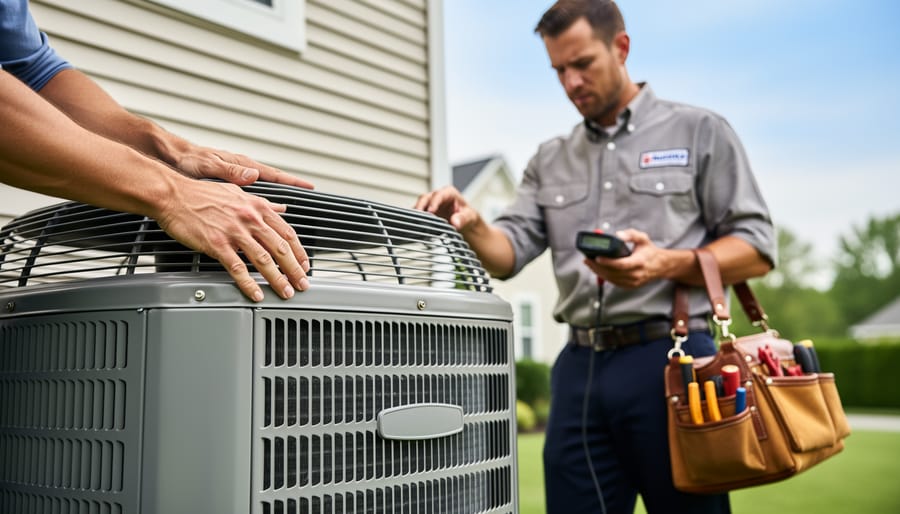
Recognize the warning signs before your AC fails completely. Strange noises like grinding or squealing, weak airflow from vents, warm air when you expect cold, and unexplained spikes in your energy bills all point to needed repairs. Most homeowners ignore these symptoms until a complete breakdown happens during the hottest week of summer, forcing them to accept whatever emergency pricing a technician quotes.
Get multiple quotes before committing to major repairs. In 2026, a standard AC repair averages between $175 and $650, depending on your location and the specific issue. Refrigerant leaks typically cost $200 to $400, while compressor replacements run much higher at $1,200 to $2,500. Just like water heater repair AC work varies dramatically in complexity, so understanding what you’re paying for protects you from unnecessary upsells.
Choose a licensed HVAC technician who provides transparent pricing upfront. Sarah from Calgary learned this lesson the hard way when she called the first company she found online. They charged her $450 for a simple capacitor replacement that should have cost $150. After sharing her experience in a neighborhood group, three other homeowners recommended a local technician who diagnosed problems before quoting prices and explained every step of the repair process.
Decide whether to repair or replace based on the 50% rule. If your AC unit is more than 10 years old and the repair costs exceed half the price of a new system, replacement makes better financial sense. A repair might get you through another season, but you’ll likely face repeated breakdowns and climbing energy costs that offset any short-term savings.
The typical AC repair takes two to four hours for common issues, though complex problems requiring parts ordering can extend to several days. Understanding what to expect helps you plan around the disruption and ask informed questions when technicians arrive.
Common AC Problems You’ll Actually Encounter
Walking into a warm house when your AC has quit feels like a genuine emergency, but the problem isn’t always what you might think. Most AC repairs fall into a handful of categories, and knowing which one you’re dealing with can help you understand what’s coming when the technician arrives.
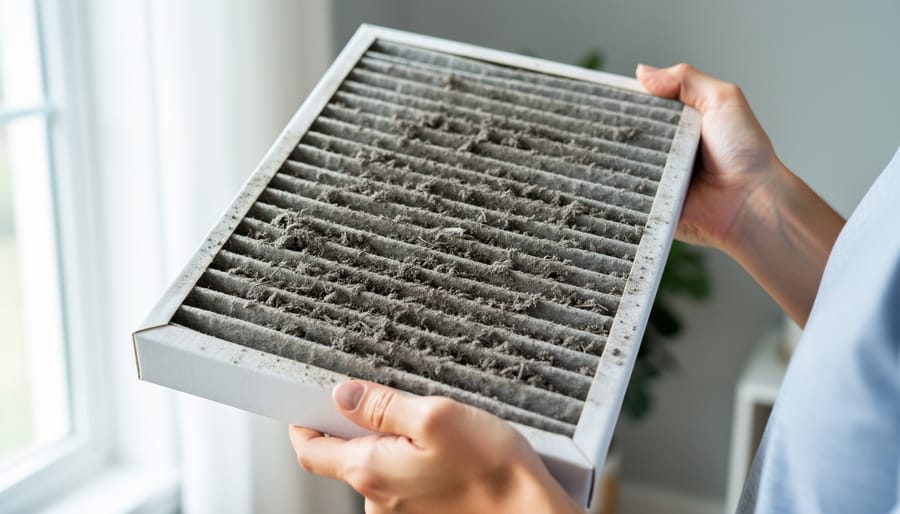
Clogged or dirty filters rank as the simplest culprit. Your AC pulls air through a filter constantly, and when that filter gets packed with dust, pet hair, and general household debris, airflow drops dramatically. You’ll notice weak air coming from vents or the system running constantly without cooling effectively. Technicians spot this one immediately during inspection, and it’s often a quick fix that doesn’t require specialized parts.
Electrical issues create trickier symptoms. Your AC might refuse to turn on at all, or it could cycle on and off repeatedly without completing a cooling cycle. Faulty wiring, blown fuses, or malfunctioning thermostats all fall into this category. Technicians use multimeters and other diagnostic tools to trace where power flow breaks down, checking connections between your thermostat, outdoor unit, and indoor components.
Refrigerant leaks cause your AC to blow warm air even though the system appears to be running normally. The refrigerant doesn’t just run out like gas in a car; something has punctured or corroded the lines. Technicians locate leaks using special detection equipment, then repair the line before recharging the system with the correct refrigerant type and amount.
Capacitor failures happen frequently, especially in older units. The capacitor gives your compressor and fan motors the electrical jolt they need to start. When it fails, you might hear humming from the outdoor unit without any actual movement, or the system won’t start at all. Replacement typically runs $150-400 for parts and labor, making it a mid-range repair in terms of cost.
Compressor problems represent the serious end of the spectrum. The compressor is essentially your AC’s heart, pumping refrigerant through the system. When it fails, you’re looking at major repairs that can reach $1,000-2,500. Technicians diagnose compressor issues through pressure tests and electrical readings, but the symptoms at home are usually obvious: no cooling whatsoever despite the system appearing to run.
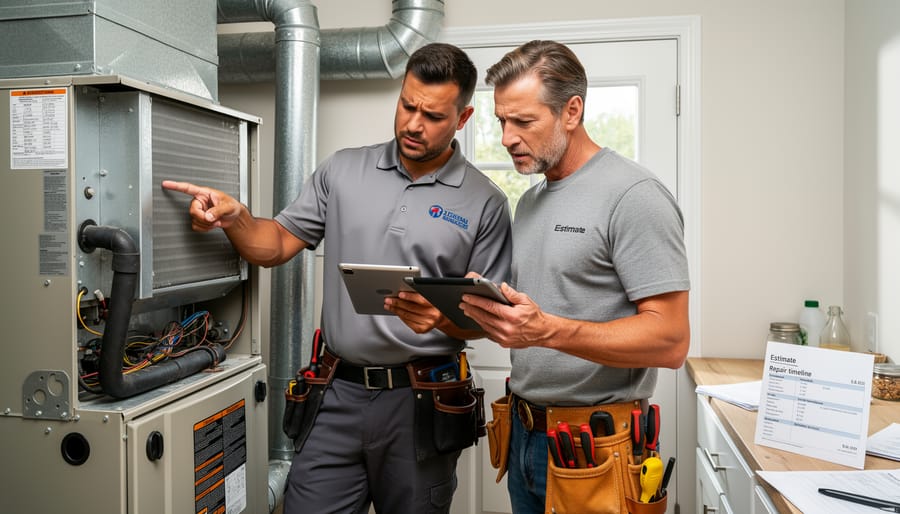
What AC Repairs Really Cost in 2026
Understanding Diagnostic and Service Fees
Most AC companies charge a diagnostic fee just to show up and figure out what’s wrong with your system. Think of it as paying for the technician’s time and expertise to inspect your unit, test components, and identify the problem. In 2026, you’ll typically pay around $99 during regular business hours for this service. Some companies waive this fee if you proceed with the repair, while others keep it regardless.
Here’s where it gets tricky: after-hours service costs more. If your AC quits on a Saturday evening or during a holiday, that same diagnostic visit can jump to $139 or higher. That’s on top of whatever the actual repair ends up costing. The fee covers the technician’s travel, inspection time, and the written estimate they provide, not the fix itself.
Before you book that appointment, ask whether the diagnostic fee applies toward the repair cost. Some companies deduct it from your final bill, which softens the blow. Others treat it as a separate charge. Understanding this upfront helps you budget realistically and avoids surprise charges when the technician hands you the invoice.
When Emergency Rates Apply (And How to Avoid Them)
Emergency AC repair rates can genuinely double what you’d pay during regular business hours, turning a $300 fix into a $600 expense. Most HVAC companies define emergencies as service calls outside standard weekday hours (typically evenings after 6 PM, weekends, or holidays), regardless of whether your AC actually stopped working at 2 AM or you just noticed it wasn’t cooling properly Saturday morning.
Here’s the reality: while a complete system failure during a July heatwave feels urgent, many situations homeowners think require immediate attention can actually wait until Monday morning without serious consequences. A true emergency typically involves extreme temperatures that pose health risks to vulnerable family members, a completely non-functional unit during peak summer heat, or water damage from a condensation leak. If your AC is still blowing air but not cooling efficiently, that’s usually a next-business-day repair, not a weekend emergency call.
You can significantly reduce emergency repair costs with some planning. Keep a portable fan or window unit as backup cooling so you’re not desperate for same-hour service. If your AC starts acting up on Friday afternoon, call immediately rather than waiting until Saturday when emergency rates kick in. Most technicians can schedule you for first thing Monday morning at standard rates if you reach out before the weekend starts. During extreme heat advisories, consider booking a preventive checkup in late spring when technicians have more availability and you can avoid both emergency fees and peak-season scheduling delays.
How Long Will Your AC Repair Actually Take?
Same-Day AC Repair: What’s Realistic
Simple repairs often get handled the same day if you call early. Clogged filters, thermostat issues, and basic electrical problems can usually be fixed within hours because technicians carry the necessary parts on their trucks. One homeowner told us his AC stopped cooling on a Tuesday morning, and after he called by 9 a.m., a technician arrived, diagnosed a faulty capacitor, and had it replaced by early afternoon.
Longer timelines happen when you need specialty parts. Compressor failures, major leaks in the refrigerant lines (similar to when you check for leaks in your plumbing), or damaged coils often require ordering specific components. Those repairs might take two to five days depending on availability. The time you call matters too. Morning appointments give technicians a full day to order rush parts if needed, while late afternoon calls sometimes push work into the next business day.
Finding the Right AC Repair Technician
Finding a qualified AC technician doesn’t have to feel like guesswork, especially when you realize that many professionals who handle service technician tasks for plumbing also carry HVAC certifications. This overlap gives you more options than you might think, but it also means you need to know what credentials actually matter.
Start by confirming the basics. In most regions, AC repair technicians need EPA certification to handle refrigerants, along with state or provincial HVAC licensing. Don’t hesitate to ask for proof, legitimate technicians expect this question and have their credentials ready. Some plumbing companies employ dual-certified technicians who can troubleshoot both your water heater and cooling system, which can be incredibly convenient when you’re dealing with multiple home comfort issues.
Once you’ve narrowed down your options, ask these questions before committing to service:
- What certifications and licenses do you hold for AC repair work?
- Do you provide a warranty on both labor and parts, and what does it cover?
- What’s your diagnostic fee, and does it apply toward the repair cost if I hire you?
- Do you stock common replacement parts, or will I need to wait for ordering?
- What are your emergency service rates compared to regular hours?
The answers to these questions tell you a lot. A technician who stocks frequently needed components like capacitors and contactors can often complete repairs the same day. One who clearly explains their diagnostic fee policy, whether it’s a flat rate or waived if you proceed with the work, demonstrates transparency about costs.
Watch for red flags that signal trouble. Pressure to replace your entire system without explaining repair options, reluctance to provide written estimates, or vague answers about licensing should send you looking elsewhere. Same goes for technicians who won’t break down costs or who insist on immediate payment before finishing the work.
Check online reviews, but read them critically. Look for patterns rather than isolated complaints. A company with mostly positive feedback about fair pricing, clear communication, and reliable repairs is worth calling. Many homeowners have found their best HVAC technicians through personal recommendations from neighbors who’ve had similar cooling problems.
Getting quotes from two or three different technicians gives you a sense of fair market rates and helps you spot anyone charging well above the typical $100-150 per hour for certified work. You’re not just hiring someone to fix a broken AC, you’re choosing a professional you can trust when the heat hits hardest.
Real Stories: What Homeowners Wish They’d Known
Sarah from Denver thought she’d found a deal when a technician quoted $200 to fix her AC over the phone. The catch? That price covered the diagnostic visit only. Once he opened the unit and found a failed capacitor, the actual repair jumped to another $350. “I wish I’d asked upfront what the quote included,” she says. “Getting three written estimates would’ve shown me that $550 total was actually fair for capacitor work, but I felt trapped once he was already there.”
Mike’s experience went differently. When his AC died during a July heatwave, he called an emergency service without checking the technician’s training and credentials. The after-hours rate hit $280 per hour, nearly double what certified technicians charge during regular business hours. “I paid $840 for a repair that should’ve cost around $400,” he explains. “Waiting until morning would’ve been uncomfortable but would’ve saved me hundreds.”
Not all stories end badly. Jessica in Portland got multiple quotes when her compressor started making grinding noises. Two companies said she needed a full replacement at $2,000-plus. The third technician, who spent more time diagnosing the issue, discovered it was actually an electrical problem. The fix cost $320 and took two hours. “The lesson? A thorough diagnostic matters more than the fastest quote,” she notes. “I almost spent thousands unnecessarily because I was in panic mode.”
The common thread in these experiences is simple: pressure leads to poor decisions. Homeowners who took time to understand what they were paying for, verified technician qualifications, and compared multiple quotes consistently felt better about the outcome, regardless of the final cost.

Making the Smart Call: Repair or Replace?
You’re staring at a $1,800 compressor repair quote for a 12-year-old AC unit. Do you fix it or start fresh?
Here’s the decision framework that actually makes sense. First, consider the age of your system. Most AC units last 15 to 20 years, but efficiency drops significantly after the first decade. If your unit is under eight years old, repairs almost always make financial sense unless you’re facing catastrophic damage. Between eight and 12 years, you’re in the gray zone where the math matters more.
Next, look at the repair cost relative to a new system. A new AC unit typically runs $3,500 to $7,000 installed in 2026. If you’re facing a $400 capacitor replacement on a nine-year-old unit, that’s a no-brainer repair. But a $2,200 compressor fix on a 13-year-old system? You’re spending roughly half the cost of new equipment on aging components that might fail again soon.
Consider your repair history too. If you’ve already spent $800 on fixes in the past two years and now face another major repair, you’re pouring money into a declining system. One big repair on an otherwise reliable unit tells a different story than repeated service calls.
Finally, think about efficiency gains. Newer 2026 models can cut cooling costs by 20 to 40% compared to units from 2014 or earlier. Those energy savings accumulate, potentially offsetting replacement costs within five to seven years, especially during hot summers when your AC runs constantly.
You’ve got the knowledge now. You understand what repairs actually cost in 2026, which problems qualify for same-day fixes, and how to spot fair pricing versus inflated quotes. Armed with realistic timelines and cost expectations, you won’t get caught off guard when your AC fails on the hottest day of summer.
Before you commit to any repair, get at least two quotes from certified technicians. Compare not just the price, but what’s included in the service fee and how each company explains the problem. Trust your gut if something feels off.
We’d love to hear your AC repair story. Did a technician go above and beyond, or did you learn a costly lesson the hard way? Share your experience in the comments below. Your insights help other homeowners navigate these decisions with confidence. When you know what to expect, a broken AC becomes a manageable inconvenience instead of a crisis.